Pool Tour - Pocket Billiards
Candy MobileSports
4.611.23K Reviews
- Version
- 2.0.1
- Installs
- 5.00M
- Age Rating
- Everyone
Screenshots
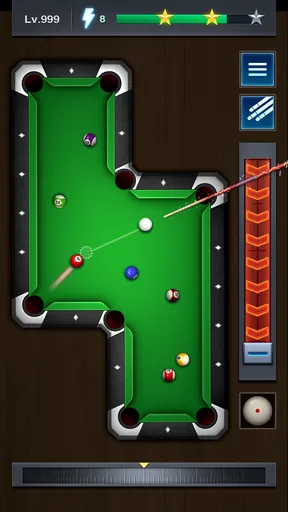
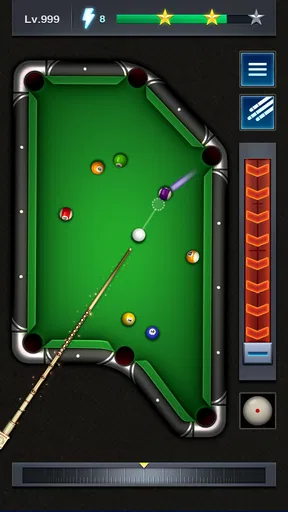
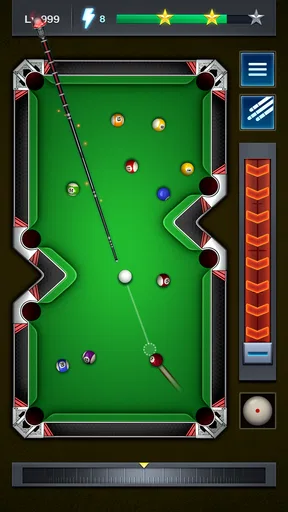

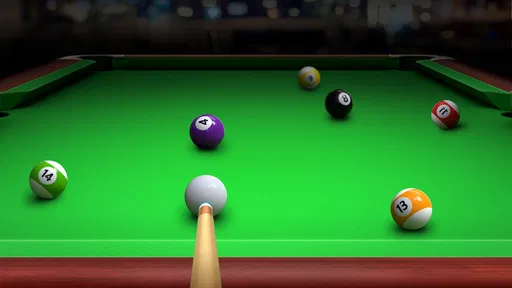
Our Review of Pool Tour - Pocket Billiards
 Analysis by Appyee
I installed Pool Tour - Pocket Billiards expecting a quick arcade pool game, and that is exactly where it makes the best first impression. The table is ready almost immediately, the controls are easy to understand, and the main pleasure comes from lining up a shot, committing to it, watching the balls react, and deciding whether I want to try again. It is a focused sports game rather than a full billiards simulator, so its appeal depends on whether you prefer fast, forgiving play over detailed realism.
Made by Candy Mobile, this free game has built a sizeable audience, with a 4.6 average from around 128 thousand ratings and more than 5 million installs. Those figures suggest that the simple format has found the right audience, but they do not tell the whole story. After spending time with it, I found a game that works especially well in short bursts, while also showing the limits of an arcade approach when I wanted deeper strategy or a more authentic pool experience.
How the shot-to-shot loop keeps me playing
I like how the shot-to-shot rhythm makes a brief session feel complete, while still giving me a reason to stay for another turn. In this section, I’ll focus on the small choices that make returning appealing, then look at how to keep those choices deliberate rather than letting quick play turn into careless swiping.
The first action is simple, but aiming still matters
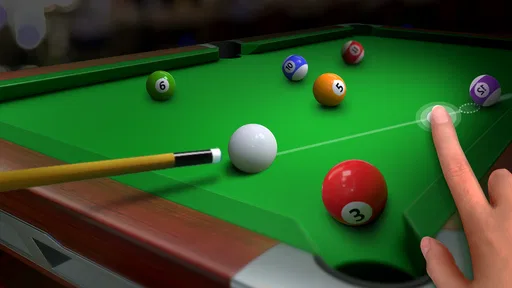
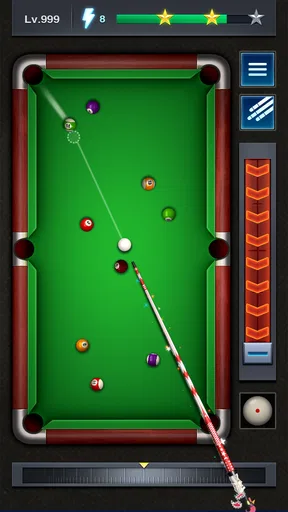
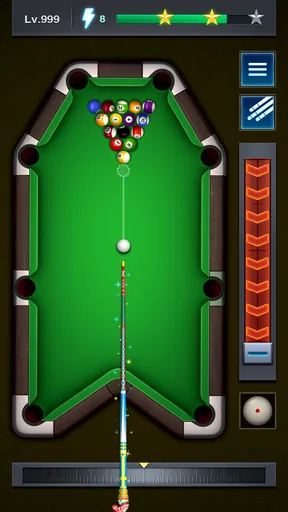
The strongest part of the opening experience is how quickly I can get involved. I do not need to learn a complicated menu structure or memorize a large collection of rules before taking a shot. The central activity is immediately understandable: position the aim, choose how much force to use, and release. That low barrier is useful when I only have a few minutes, because the game gets to the point instead of making me work through setup screens.
That simplicity should not be confused with total lack of precision. A careless angle can turn a promising attempt into a bad position, and excessive force can create a result I did not want. I found myself making small adjustments rather than dragging the aiming line around randomly. The game rewards a calm approach: check the intended contact point, consider where the cue ball may finish, then take the shot. It is still arcade pool, but the basic visual feedback gives each decision some weight.
For a new player, the most useful habit is to stop treating every shot as an attempt to sink the nearest ball. I had better results when I considered the next position as well. Even without advanced simulation, thinking one shot ahead makes the rounds feel less automatic. This is one of the less obvious strengths of the design: the controls are approachable enough for casual play, yet they leave room for small improvements in judgment.
The touch controls are best suited to a phone held comfortably in both hands. On a smaller screen, I needed to be deliberate when adjusting the line, especially when two balls were close together. That is not a serious flaw, but it means rushed swipes can feel self-inflicted. If I slowed down for a moment, the same shot usually became much easier to read.
Feedback gives every attempt a clear rhythm
The game’s feedback loop is built around a satisfying sequence. I aim, pull back, strike, and immediately see whether the contact worked. A successful shot changes the table and creates the next decision; a miss leaves me with a visible reason to reconsider my angle or strength. That direct connection between action and result is what makes another attempt tempting.
I particularly like that the table itself becomes a record of my previous decision. When a ball drops, the situation simplifies. When a ball stops in an awkward place, I have to adapt rather than simply repeat the same gesture. This keeps the experience active even when a round is not going perfectly. The best moments are not necessarily spectacular clears; they are the shots where a small correction produces a noticeably better outcome.
At the same time, the feedback is clearly designed for accessibility rather than strict tournament realism. Players who want detailed cue-ball physics, nuanced spin control, or the exact pressure of a serious billiards simulator may find the interaction too light. The game communicates success quickly, which is good for casual sessions, but it also reduces some of the uncertainty that makes real pool demanding.
That trade-off affects who should play it. I would recommend it to someone who enjoys the visual satisfaction of pocketing balls and wants controls that can be understood in seconds. I would be more cautious about recommending it to a player who already spends time studying real-world break strategy, defensive safety play, or advanced cue-ball positioning. The game can encourage those ideas in a basic way, but it is not built around reproducing every technical detail.
Small rewards make progress feel immediate
Pool Tour works because the reward arrives close to the action. A well-judged shot produces a visible payoff straight away, and completing a sequence gives me a reason to continue instead of closing the game after one turn. The reward is not only a score or a completed table; it is also the feeling that my next attempt can be cleaner than the last one.
This is where the arcade identity becomes useful. A realistic pool game might ask me to accept a slower pace and more complicated controls before I see improvement. Here, the game lets me experience progress through repetition. I can make a mistake, understand it quickly, and apply a different angle or power choice on the following shot. That structure is friendly to beginners and works well for players who want a low-pressure way to pass time.
My practical tip is to use each successful shot as information rather than simply as a point. Notice how much power produced the result, observe where the cue ball ended, and use that knowledge on the next attempt. This turns a basic arcade round into a small practice routine. I found that this approach made the game more engaging than trying to rush through every table.
The limitation is that quick rewards can also make the experience feel repetitive if I am looking for a larger sense of progression. The core pleasure remains tied to the same action: aim, strike, watch, and repeat. Players who need a broad career structure, extensive customization, or a strong competitive ecosystem may eventually want a more feature-heavy alternative. This game’s strength is concentration, not variety for its own sake.
Resetting after a miss keeps frustration under control
A missed shot does not have to end the session emotionally. Because the action is compact and the next opportunity arrives quickly, I can reset my approach without carrying too much frustration from the previous attempt. That matters on a phone, where I may be playing while waiting for transport, taking a break, or relaxing before bed. I can stop after a single short session, or continue when I feel that one more attempt might go better.
The reset is also useful for learning. Instead of blaming the entire round, I can isolate the mistake: was the line wrong, was the power too strong, or did I fail to think about the cue ball’s finishing position? That short review makes the next attempt purposeful. In my experience, the game is most enjoyable when I treat failure as a prompt to adjust rather than as a reason to play more aggressively.
There is a downside for players who prefer long-form matches with a strong sense of consequence. A fast reset can make mistakes feel less meaningful, and the arcade presentation may not provide the same tension as playing against a human opponent in a carefully structured match. If your ideal pool experience involves extended concentration, social competition, or highly specific rules, this may feel more like a pocket-sized diversion than a complete replacement.
It is also worth considering the age and device requirements. The game is rated Everyone, making it suitable for a broad audience, and it supports devices running Android 6.0 or later. The current version is 2.0.1. Those details make it a practical choice for people using an older compatible Android phone, although the actual comfort of aiming will still depend on the screen size and responsiveness of the device.
Why another session begins
The reason I return is not that every round feels radically different. It is that the game creates a clean chain of small decisions. A good shot encourages me to see whether I can repeat the result. A poor shot makes me want to correct the angle. A nearly successful attempt is especially effective because it suggests that a minor change could be enough. That is a strong casual loop: action, immediate feedback, a modest reward, a reset, and a clear invitation to try once more.
That loop is most convincing in everyday situations. Imagine having a short break with no interest in starting a large game. I can open this one, take a few shots, and put it away without needing to remember a complicated story or manage a long inventory. If I have a little more time, I can stay for several rounds and focus on improving my control. The game fits both uses because its basic interaction is quick to enter and easy to leave.
It also suits a beginner who wants to understand the basic relationship between angle, force, and ball position. I would not use it as a substitute for practicing on a real table, but it can make those concepts feel approachable. The visual nature of the shot gives immediate feedback, and the low-pressure format allows experimentation. A player can try a softer touch, a different line, or a more patient setup without feeling that every mistake has ruined a long campaign.
On the other hand, I would skip it if my priority were authentic simulation. A dedicated billiards simulator is a better choice for someone who wants detailed spin, realistic table behavior, formal match rules, or a more demanding competitive environment. I would also look elsewhere if I needed a game built around deep social interaction. Pool Tour is at its best as a direct solo arcade experience, not as a replacement for every kind of pool game.
Another useful distinction is between casual repetition and content variety. If I enjoy refining one familiar action, the focused design is an advantage. If I need constant new mechanics to stay interested, the same focus may become a weakness. The correct expectation is important: this is a free sports game centered on accessible pool play, not a broad sports collection or a full management experience.
What I would change in my playing routine
I found three habits especially helpful. First, I stopped using maximum power by default. Strong shots can look exciting, but a controlled stroke often leaves a more manageable table. Second, I began checking the cue ball’s likely resting place before committing. Even when the game is forgiving, that extra glance improves the next decision. Third, after a miss, I changed one factor at a time. Altering the angle and force together made it difficult to understand what had gone wrong.
These habits are small, but they give the loop more depth without making the game feel like homework. They also help answer a common practical question: can a complete beginner enjoy it without knowing pool terminology? Yes. The basic controls are approachable, and the player can learn through visible results. The extra thinking becomes useful only when the player wants more consistency, so beginners are not forced to master it immediately.
Another question is whether it works for very short sessions. In my experience, yes. The game’s strongest use case is a quick break where I want an activity with an immediate payoff. It is less suitable when I want a long narrative arc or a match that feels like an event. That difference is not a defect by itself; it simply defines the kind of attention the game expects.
My verdict on the complete loop
Pool Tour - Pocket Billiards succeeds because it understands the value of a clear first action. I can aim, strike, and see the consequence without unnecessary friction. The feedback is readable, the reward arrives quickly, and a miss rarely feels like a reason to quit. That makes it an easy recommendation for casual Android players who want free pool action with an Everyone age rating and a low learning curve.
Its weaknesses come from the same design decision that makes it approachable. The arcade handling may feel too light for serious billiards fans, and the repeated shot-to-shot structure will not satisfy everyone looking for extensive variety or a deeper competitive format. I would choose a more realistic pool title for technical practice, and a socially focused game for multiplayer interaction. For short solo sessions, though, Candy Mobile’s game has a dependable rhythm that keeps pulling me back.
The release arrived on April 13, 2020, and the current version remains 2.0.1, but the important point for me is how well the central loop still fits mobile play. It does not need a large commitment to be enjoyable. I open it for one attempt, receive an immediate lesson from the table, and often stay because the next shot feels close enough to improve. If you want quick pool decisions, visible feedback, and an easy reset after mistakes, this is a worthwhile free download; if you want a detailed simulation, choose something more specialized.
Privacy and Permissions
See what permissions an app requests and how it handles your data.
- Wi-Fi connection information
- view Wi-Fi connections
- Other
- view network connections, full network access, control vibration, prevent device from sleeping, Google Play license check
Verdict
Strengths of Pool Tour - Pocket Billiards
- Simple controls make it easy for beginners to start playing.
- Quick matches are ideal for short gaming sessions.
- Several table and cue options add variety to the experience.
- Offline play lets you enjoy matches without an internet connection.
- Physics generally feel responsive during normal shots.
Limitations of Pool Tour - Pocket Billiards
- Ads may interrupt gameplay or appear frequently between matches.
- Advanced players may find the computer opponents predictable.
- Some upgrades or items may require extra grinding to unlock.
- Touch controls can feel imprecise when aiming delicate shots.
- The game offers limited depth compared with full billiards simulators.
Other Releases by Candy Mobile
View All
Coloring Book: Color by Number
Board4.5

Anima Color - Paint by Number
Board4.6
Similar Picks in This Category
View All
8 Ball Pool
Miniclip.com4.8

Pooking - Billiards City
AIM TOP GAME TECHNOLOGY LIMITED - pool4.6

Carrom Pool: Disc Game
Miniclip.com4.4

EA SPORTS FC Soccer Mobile 26
ELECTRONIC ARTS4.6

World Soccer League
mobirix4.3

Soccer Cup 2026: Football Game
INLOGIC SPORTS - football tennis golf soccer4.3
Frequently Asked Questions
What is Pool Tour - Pocket Billiards?
Pool Tour - Pocket Billiards is a mobile billiards game focused on quick, accessible pool matches. It lets you practice your aiming, control shot strength, and compete across different tables and challenges. The game is designed for casual sessions, but its progression system and increasingly difficult opponents can also appeal to players who enjoy improving their technique over time.
Can I play Pool Tour - Pocket Billiards offline?
The game may offer offline play for certain single-player modes, practice sessions, or previously available content, although features that depend on an internet connection can be restricted. Online competitions, advertisements, leaderboards, cloud synchronization, and some rewards may require connectivity. Before downloading, check the current store description because offline availability can vary between versions and devices.
Is Pool Tour - Pocket Billiards free to download?
Pool Tour - Pocket Billiards is generally available as a free download, allowing players to try the main gameplay without paying upfront. However, free versions may include advertisements, optional purchases, or systems involving coins, energy, upgrades, or other virtual items. These purchases are not always necessary to enjoy the game, but they can affect progression and should be reviewed before playing.
How does the gameplay and progression system work?
Gameplay is based on lining up shots, adjusting the cue direction, controlling power, and attempting to pocket balls according to the selected challenge. Successful matches usually reward coins, experience, or progress toward new tables and stages. As you advance, opponents and objectives can become more demanding, so careful positioning and planning are often more important than simply hitting the cue ball with maximum strength.
What should I know about ads, permissions, and device compatibility?
As with many free mobile games, Pool Tour - Pocket Billiards may display advertisements, particularly between matches or when claiming bonus rewards. It can also request network access for ads, updates, online services, or analytics. Performance depends on your phone or tablet, operating system, available storage, and graphics capability. Reviewing the latest Google Play or App Store listing is recommended for current requirements and permissions.
Play our best games!


